Angry Doctor

Monday, January 18, 2010

When I was a houseman...

angry doc used to work with a (not much more) senior colleague who used to start every other discussion with the phrase "when I was a houseman...".

Prof Lee now does the same in her latest article in the papers:

(exerpt)

Time to reverse 'narcissism epidemic'
The young today are more self-centred and less driven, possibly due to their upbringing


The principal of a mission school invited me to give a talk to his teachers recently.

'The purpose of inviting guest speakers to the school is to open up my teachers' minds about new possibilities and the demands of the real world,' he told me.

I was unable to give the talk but volunteered one of my doctors, an old boy of the school and a superb and compassionate doctor. I told the principal: 'My perspective on the education of these relatively elite boys is to teach them that they owe society a duty.'

The principal agreed, but observed: 'Unfortunately, given the changes in Singapore... my teachers are increasingly pushed by larger societal forces that worship the relentless pursuit of academic excellence as a means of material gain... While there is nothing wrong with pursuing academic excellence, it cannot be an end in itself.'

I and many other senior doctors have noticed that a significant percentage of newly graduated doctors are more self-centred and less hard-working than we were.

For example, there are more house officers with each passing year, and in some departments, there seem to be too many of them. The total work has not increased much, but this is divided among more house officers. Yet house officers complain that they are stressed out and they cannot cope with the work.

When I was a house officer, there was no payment for being on call. As a medical officer, I was paid $40 for the first four calls in the month, and $100 for each subsequent call. There were no mandatory maximum or minimum number of calls for house officers or medical officers.

But some time after 1990, house officers were not allowed to do more than six calls a month and medical officers were not allowed to do more than four calls. House officers are now paid $110 a call on weekdays and $150 on weekends. Medical officers are paid $210 a call on weekdays and $300 on weekends.

We used to have to do eight to 10 calls a month, and the number of patients I saw each time I was on call was considerably more than the numbers seen by house officers and medical officers today.

But despite having to do less work, junior doctors apparently have less time for self-study today.

Consequently, many training programmes now set aside 'protected time' during working days for them to study. In addition, most departments have structured teaching programmes for young doctors - a far cry from the bad (or good) old days when there was no time during working hours for structured teaching and most of us learnt from patients or senior doctors. And to reinforce our knowledge and ensure we missed no crucial information, we would read a standard textbook from cover to cover.

All of the above would appear to be exceedingly difficult for the present generation of junior doctors. For some years, I wondered whether this was the fault of our medical school or indulgent parents."


angry doc belongs to the generation of doctors who benefitted from the enlightened view that doctors should be paid appropriately for their time on calls ($40 for an overnight call would be way below minimum wage if we had one) and that they should not (in theory) be made to work more than six calls a month. Nevertheless, his personal record was 11 calls in one month, and he can remember a few where he did not catch a single minute's sleep.

Housemanship in his days was tough - angry doc has seen it reduce grown men and women to tears - and even then angry doc heard his share of "when I was a houseman" from his senior doctors. angry doc is willing to bet that as a houseman, Prof Lee too got her fair share of "when I was a houseman" from her senior doctors, who remembered how housemen were better in the days of the Raj.

Do junior doctors have it easier these days? Certainly. But that precisely why the changes Prof Lee mentioned (limiting number of calls, structured training, protected time) were implemented - we want to make learning a less stressful experience than what we went through ourselves, and we want it to be safer for everyone.

Does it matter that the youths of today are 'less tough' than we were? angry doc doesn't think so. The whole point of training for junior doctors is to produce doctors who can function in their role in an efficient and safe manner. They may not have to do 11 calls a month, or take blood for 40 patients in one morning, but they face a more demanding generation of patients (and relatives), and the volume of new information and evidence they have to assimilate and incorporate into their practice is enormous. The old challenges are not the challenges they *need* to face today, just as we did not have to face the challenges that they face today when we were housemen.

At the end of the day, when angry doc is ill, he doesn't want a tough doctor who has done his 10th call this month, or a humble guy who thinks he owes society a debt - he wants someone who is rested and has had plenty of time to learn about the condition for which angry doc has been admitted for. It matters not to angry doc that the doctor might have a "positive" opinion of himself - as long as he can do what his job grade requires, it is not an "inflated" view.

Labels:

Saturday, January 24, 2009

To write is to sit in judgement on oneself

A comment on the previous post on the issue of "decorum" set angry doc thinking about his blogging.

As a young doctor angry doc was taught never to "run down" (yes, that was the exact term used) another doctor in public. The Singapore Medical Council's Ethical Guidelines advises that:

"A doctor shall refrain from making gratuitous and unsustainable comments which, whether expressly or by implication, set out to undermine the trust in a professional colleague’s knowledge or skills."

It seems to angry doc that the SMC's position is more enlightened than the "you don't talk about the Fight Club" rule he grew up with - one should be allowed to criticise if one can substantiate one's criticism, and if the primary aim is not to undermine a colleague.

Our knowledge is imperfect, our system is imperfect, and we ourselves are imperfect; it is inevitable that healthcare professionals will notice when things fail or go wrong, and it is unrealistic to expect them to not speak up while requiring them to provide safe and high-quality patient care. The question then is what setting, what platform should a doctor utilise to voice his or her concerns?

Prof Lee chooses the print media as her platform, and angry doc has chosen a blog.

There are literally hundreds of topics angry doc can blog on, so how does he decide what he blogs on?

angry doc thought about it last night, and he concluded that he writes about things that:

1. He is interested in. Of course; why bother otherwise?

2. He can substantiate. Rants and opinions aside, angry doc tries to gather information and check his facts before he writes on a topic, and he invites readers to correct him where he is wrong.

3. He can get away with. The point that the commenter alluded to at the beginning of the post made, angry doc believes, is that Prof Lee may be able to get away with saying certain things when others may not. angry doc doesn't know if Prof Lee can get away with it, but he certainly thinks there are topics which he cannot get away with criticising.

So at the end of the day, angry doc may be better judged on what he doesn't blog about, rather than what he does blog about.

Maybe.

Labels:

Thursday, January 22, 2009

The heart has its own reasons...

No, this is not another post about true love, but a follow-up to a question posed by angry doc's teacher in the previous post:


What do you think about the changes in SCDF policy in today's ST re: pts with Acute myocardial infarcts?


angry doc did not read the story mentioned, but an article in Today today gives the background to the issue:


"Dr Lee Wei Ling, the director of the National Neuroscience Institute, wrote in a Sunday Times column that the two hospitals did not have the resources after office hours to handle heart attack patients."

"In her article, Dr Lee wrote that she had engaged ambulances under the Singapore Civil Defence Force, NHC and NUH, and got them all to agree to bypass the two hospitals if they pick up acute heart attack patients."


So is it a good policy to send all patients with acute heart attacks to NHC or NUH?

Management of acute heart attacks is not angry doc's area of specialty, but in general where both options are available, primary anigoplasty ("angioplasty operations... as a first course of treatment if needed") is superior to thrombolysis ("just medication to break up or dissolve blood clots").

In the event that primary angioplasty is not available at the nearest hospital and the nearest centre that does provide the service is several hours away, thrombolysis may be a valid option (feel free to correct angry doc if you know he is wrong); but is it a valid option in the local context?

angry doc does not have the answer, but it is not important, because Prof Lee's article (reproduced on this page) wasn't really on the availability of cardiac specialists in certain hospitals after office hours, but her belief that:


If there is something wrong that we know of, I believe we should try to set it right whether or not it is our business to do so. Not to do so implies we condone the wrong and hence we would be guilty of committing the wrong too.


So even though Prof Lee's recommendation for all patients with acute heart attacks to be brought to NHC or NUH may have been rendered moot by changes which have taken place, angry doc cannot fault her reason for speaking out.

Labels: ,

Saturday, July 14, 2007

How much is that doctor in the window? 9

angry doc wasn't planning to blog about this topic, but since Prof Lee thinks it's important enough for her to write to the ST Forum (emphasis mine)...


Why single out doctors as being mercenary?

IN THE letter, 'Concern over senior docs going into private practice' (ST, July 12), Ms Annie Koh Seok Kien laments the increasing numbers of doctors leaving restructured hospitals for private practice.

The past two years have seen an increasing number of foreign patients, driving up the income of specialists in private practice, while the remuneration of doctors in the public sector has remained largely unchanged. The income gap between medical specialists in the private and public sectors is now blatantly obvious to the entire medical fraternity.

Students apply to medical school for a variety of reasons. Whatever the initial reasons, when they graduate and subsequently set up families, even those who remain extremely altruistic have to start planning to accumulate wealth as any responsible parent would.

Even if their initial aspirations were to send their children to a local university, as the potential for earning more arises, their aspirations may now be to send their children to top universities overseas.

These are natural instincts which ensured survival of homo sapiens over milleniums. Even politicians and civil servants whose ambition is to serve the nation harbour these same aspirations. Why single out doctors as being mercenary?

Indeed, there are some doctors who are unscrupulous. This is possible in private practice where there is no regulation to prevent overcharging. These are not the doctors we would want to retain in the public sector.

Speaking for the doctors at the National Neuroscience Institute, a restructured hospital, as long as the difference in income is not too great, the working conditions reasonable and fair, and there is a sense that we are providing the best patient care we can, we are happy to stay on in the public sector to serve all patients who need us.

But if the gap gets greater as it is threatening to, I would not hold it against any of my colleagues with families who leave for the private sector. I only hope that in private practice, they will still be guided by their conscience when dealing with patients.

The price of medical care does not follow the rules of supply and demand because the consumer (the patient) can never be fully informed and usually goes to the doctor with total trust, submits to various procedures recommended and seldom questions the fees that are eventually charged. That is the reason why private practice can be so lucrative.

Associate Professor Lee Wei Ling
Director
National Neuroscience Institute


Well, angry doc doesn't think 'why single us out?' is a valid defence, nor that the freedom to overcharge patients is the only or primary reason for doctors joining the private sector.

By the same token, it doesn't mean that all those who leave the public sector are greedy and unscrupulous, or that those who remain are all virtuous and self-sacrificing.

Doctors in the public and private sectors are not opposites of each other, nor is the relationship between the public and private sectors always antagonistic. In fact, as this article by The Hobbit explains, the two may be much more dependent on each other than we sometimes realise, and the existence of an 'attractive' private sector may not always be to the detriment of subsidised patients, as Ms Koh feared.

Labels: ,

Tuesday, June 26, 2007

Madness 3

angry doc nearly missed this letter from Prof Lee, published last week:


Don't be too harsh on families who abandon kin

THE article, 'Long-stay mental patients strain IMH' (ST, June 11), highlighting the plight of patients at the Institute of Mental Health who have been abandoned by their family, paints a sad story, placing the blame on irresponsible relatives and society in general.

Little does the reporter or the lay public know the burden of looking after a patient with chronic mental illness.

Mr Raymond Anthony Fernando's letter, 'Govt support needed to care for the mentally ill' (ST, June 22), is atypical only because he has chosen to shoulder his burden instead of dumping his wife at IMH.

By doing so, he sacrificed a significant portion of his life. His is not the worst-case scenario because his wife has recovered. For the families of mentally-ill patients who do not achieve a remission, the burden can be overwhelming.

While I do not condone the families abandoning their relatives at IMH, I can understand why they do so.

I would like to praise IMH for doing a great job in keeping these mentally-ill patients off the streets and giving them a decent quality of life. The alternative would be to deinstitutionalise these patients, as is the politically-correct policy in Western countries. This would result in many of the patients ending up as vagrants or bag-people, with maybe a few ending up in prison.

We need more chronic stay facilities, not just for chronic psychiatric patients but also adult patients with mental retardation and other handicaps who are now physically too big for their elderly parents to look after; likewise for demented patients who may be difficult to nurse at home.

While we would like the families to take on the care-giving responsibility, as a neurologist I have seen the lives of all the family members ruined by one ill relative, through no fault of their own.

Let's be realistic: If we find ourselves in the situation of these families, what would we do? If I were a patient, I would certainly not wish to burden my family or society. But as a 'First World' society, we owe our less-fortunate members a minimum quality of life with dignity.

Assoc Prof Lee Wei Ling


You can read the article mentioned in the letter here (archived at this site, which aims to 'promote mental illness awareness and fight the mental illness stigma in Singapore).

We've looked at the issue of 'home care' before. As much as we would like to think that a patient is best cared for at his own home by his own family, angry doc believes that in some cases, home care is beyond the expertise and finances of the family.

Is having more chronic stay facilities the solution? Certainly it has to be part of the solution, but angry doc thinks that more importantly, we need to change our perception of what placing a relative into a chronic stay facility means.

If we see placement of relatives not as 'abandonment' or 'dumping', but a means to ensure that they receive adequate care and supervision while the other members of the family can carry on with the other tasks of their lives, it will probably reduce the sense of guilt and resentment experienced by all parties concerned. Placement does not have to mean abandonment, and family members can still visit or even bring the patient (or should I say resident) for home leave when the demands of life are lighter. Options like daycare or home-visitation programmes can also be explored.

It might take a while for us to get there, but when you come to think about it, daytime childcare is already almost universal here.

Labels: ,

Tuesday, March 20, 2007

Confidence Goods 5

angry doc repeats himself, he knows, but he thinks this point bears (pun intended) repeating...

A reality check on how hospitals view subsidised patients
Letter from GOH KIAN HUAT

I REFER to Associate Professor Lee Wei Ling's letter, "It's not a numbers game" (Mar 13).

Patients should feel relieved that public hospitals and doctors are not recognised first and foremost for the number of private patients they bring in, and that institutions like the National Neuroscience Institute (NNI) always accord quality of patient care the first priority.

We should recognise, though, that not every health plan, hospital, doctor or nurse gives high quality care. Quality varies, for many reasons.

Quality healthcare means doing the right thing, at the right time, in the right way, for the right patient.

In public hospitals, the waiting time to see a specialist is generally long, while the time spent in consultation with a doctor is usually very short — maybe five to 10 minutes.

In the process of delivering patient care, doctors must look through a patient's history, then check the patient and prescribe a treatment plan in the presence or absence of a nurse. Under such circumstances, how would the hospital know the level of quality of patient care delivered by their doctors?

How is healthcare quality measured? How are patient satisfaction and treatment and prevention of an illness measured? How are errors detected and rectified?

Generally, subsidised patients are assigned to junior doctors. If they are lucky, they may get to see a senior doctor. Private patients, if they do not specify the doctor of their choice, are assigned to a senior doctor automatically. In addition, they enjoy shorter waiting times.

Ideally, healthcare should be non-discriminatory, providing the same quality of service regardless of race, ethnicity, age, sex, health and financial status. However, it is common knowledge that private patients enjoy better facilities and services than subsidised patients.


By and large angry doc acknowledges the concerns raised by Mr Goh. They are relevant to all 'stakeholders' in the healthcare partnership: doctors, patients, and administration.

However, angry doc makes a distinction between the quality of healthcare provided and the quality of service provided.

angry doc cannot deny that private patients may enjoy better facilitites and *services* than subsidised patient, and that these advantages (shorting waiting time, longer consultation time, ability to afford more expensive drugs and treatment) do translate to better care, but that does not mean that subsidised patients receive low-quality *care*.

How do we measure the quality of care then?

Well, it depends on whose angle you are looking at it from, doesn't it?

Mr Goh gives a good definition: "Quality healthcare means doing the right thing, at the right time, in the right way, for the right patient."

But even if we can all agree on this definition, one can easily imagine the difficulty we will have in agreeing on what 'the right thing', 'the right time', 'the right way' and 'the right patient' mean. We can try to be objective, we can track objective data like waiting times, costs, clinical parameters and so on, but unless we can agree on what constitute 'right-ness', we will just be gathering a lot of data and not convincing anyone.

Healthcare being a confidence goods, angry doc prefers to rely on the good old-fashioned concept of medical paternalism, and a 'separation of powers': a discerning patient may be the best judge on quality of *service* received, but a good doctor will be the best judge on the quality of *care* delivered. He is not quite sure where the administrator comes in though...

Labels: ,

Thursday, February 22, 2007

Click here to donate

A few weeks ago angry doc had a patient who wanted to have his Advanced Medical Directive witnessed and his body donated to science after his death. He was quite disappointed when angry doc told him that he did not do the first any more, and that he had no idea how to have the second done.

But thanks to this letter from Prof Lee in the ST Forum today, angry doc now knows how.


Organ transplant: Unease over last-minute opt-out

THE recent incident in which a brain-dead patient's family tried to physically obstruct the operation to harvest his organs for transplant into patients needing them has revived the discussion about brain death and even led to calls to amend the Human Organ Transplant Act (Hota) itself.

Some doctors have called on the authorities to respect the feelings of the family of potential donors. Given a choice, the vast majority of families would object strongly if they thought this could prevent their loved one's organs from being removed. Even with the Hota, there is a shortage of organs forcing some desperate Singaporeans to go overseas in search of organs.

The only incentive at present not to opt out is that those who opt out go to the bottom of the waiting list if they ever need an organ. Justice would not be done if these people could still opt out at the point of brain death if their family objects vigorously.

For the few Singaporeans who want to go beyond the Hota and donate any organ that can be used for transplant, there is a separate organ donor form where one can specify which or all organs one wishes to pledge.

This used to be a paper form which could be obtained from the Ministry of Health (MOH) in the 1990s when I did so. Perhaps it is now available on MOH's website.

Dr Lee Wei Ling


Indeed it is. Some browsing on the MOH site reveals that donating one's organ for transplant and to science comes under the Medical (Therapy, Education and Research) Act (or MTERA).

You can download the form here.

I learn something new every day...

Labels: , ,

Tuesday, February 06, 2007

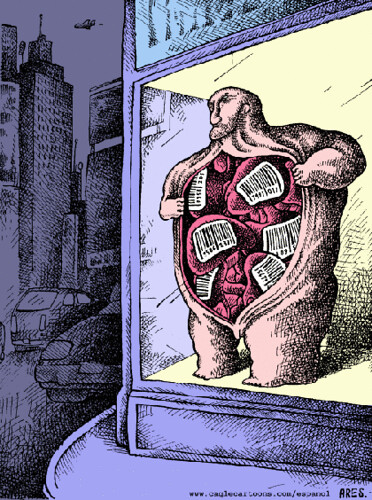
How much is that kidney in the window?

(source: http://caglecartoons.com/)

angry doc could almost hear Prof Lee's sardonic voice in his head as he read her latest letter on the ST Forum page today.

An organ is no different from a life-saving drug

THE debate about allowing the sale of organs has revealed an amusing aspect of human nature: 'If my welfare is not compromised, I can afford to espouse the politically correct view', human organs are sacred and should not be traded like a commodity.

However, the cold reality is that there are people suffering and dying because no organ is available in Singapore. These patients do not think it wrong that they buy an organ.

A similar situation is where pharmaceutical companies require strong laws upholding their patents to survive and make a profit. This is a major incentive for them to set up factories and do R & D in Singapore. They spend millions, and sometimes billions, to create new drugs. Patents allow them to make back their money. Otherwise, new cures may not be found.

On the other hand, the patients who can benefit from but cannot afford these new drugs which are still protected by patents rant, rave and, in certain countries, riot because they feel their health is more important than economic justice.

I suggest that we be cool- headedly but compassionately logical. What makes an organ more sacred than a medical device or medicine that can save a life? The supplier of the organ or the pharmaceutical company producing the new drug must be appropriately remunerated or there would be no incentive to part with the organ or undertake the R & D required to produce a safe and effective drug.

Whether the public and patients like it or not, these are the facts. Everyone stands to lose if we choose to ignore these facts and use arbitrary moral arguments to support a certain stance and enforce the illogical stance by law.

Assoc Prof Lee Wei Ling

Prof Lee summarises angry doc's view on the whole organ-for-sale debate succintly in her first paragraph.

angry doc's first response to Prof Lee's comparison between drug patents and organs was that one involved direct risk to a human being while the other didn't. But of course he is wrong - drug trials involve human test subjects, and occassionally adverse effects and deaths do result from them.

angry doc admits that he is squeamish about the whole idea of a living-donor organ transplant, let alone a transplant where the donor is paid to undergo the surgery. It comes from an old belief that healthy persons should not be subject to surgical risks. Of course, how much donor mortality and morbidity is considered acceptable is a subjective judgement.

As an exercise, do ask yourself how much donor mortality and morbidity risk in a liver transplant you would consider acceptable, and then compare your answers with the figures in this article.

So is it safer, or riskier than you had thought?

Labels: , ,

Monday, October 24, 2005

Angry Professor - Part 3

There have been many letters following Prof Lee's on the ST Forum, but I haven't had time to comment on all of them. I would like however to respond to Anonymous at 8:25pm, who commented on my post.

Dear Anonymous,

If you are who I think you are, we have met. I welcome you to the blog, but I shall remain behind my cowardly anonymity for reasons stated previously.

No doubt 'happy endings' and 'success stories' involving individuals with disabilities exist. But that fact that such 'against the odds' stories receive publicity underlies the fact that for many, life remains a constant struggle and a strain on the emotions, time, and finances of themselves and their families.

How many unhapy stories are there to one happy story?

How many unhappy stories is one happy story worth?

And I don't just mean that in terms of money, but also in terms of the pain and anguish felt by those concerned.

Anecdotal stories may inspire, but doctors have a responsibility to temper hope with reality. We cannot just tell the patient how someone else struck the jackpot, we must also tell them what the odds are are how high the stakes are.

Specific to the issue of genetic counseling, my personal belief is that it is one thing to have an unplanned pregnancy or a child with an unexpected abnormality, but another altogether when parents attempt to 'beat the odds' and try for a 'normal' child when significant risks of an inherited disorder is already known.


And that is not to say that individuals who suffer from disabilities and their families do not deserve our help and support.

I wish you the best.

Thank you.

Labels: ,

Wednesday, October 12, 2005

Angry Professor – Part 2

As expected Prof Lee’s letter generated a few replies on the ST Forum yesterday and today.

I counted five letters, all criticising her point of view, some denying that Singaporeans who donated to the patients’ families were gullible, and all citing that heart and hope were more important that science in these cases.

They all seem to have missed Prof Lee’s points.

The truth of the matter is, from the onset Singaporeans were duped into donating money without being given all the facts.

Ask yourselves: how did they find out about the cases?

Answer: The press.

How much did they know about the clinical facts behind the cases?

Answer: As much as the press told them.

Would they have continued to donate so generously if they had known that these "were cases who would not benefit from surgery"?

I think many still would, but I also believe almost all of them donated out of the hope and belief that the poor children will benefit from the operations, and that many now ask themselves why the low chances of a good outcome were not explained to them by the press.

At the end of the day, the press had what they wanted - sensational stories, heart-warming tales of generosity, tales of the miracle of modern medicine, and a sense of the journalist’s duty well-done.

But that there were no miraculous recoveries that lasted. And worse still, there might not have been any miraculous recovery to hope for to begin with.

So yes, I agree that they were gullible, even if it was due to the goodness of their hearts.

The second, less explicit point that Prof Lee wanted to make, I believe, was the point about full disclosure, which was countered by the issue of ‘hope’.

As doctors, we often have to inform patients and their families about their diagnoses and the treatment options available to them. Most of the time it’s pretty straightforward, but in cases of cancer or neurosurgery, things can get more complicated.

It’s hard for patients and their families to accept that sometimes, no matter what we do, the outcome will not be what they hope for: a full and complete recovery.

Sometimes the treatment prolong life a bit more, but leave the patient in an uncommunicative state.

We understand how difficult it can be for the patient’s family to cope with having a relative in a vegetative state long-term. OK, we don’t fully understand, but we can see their pain.

One patient’s mother told my senior in neurosurgery, after seeing her son a vegetable for weeks, that he “tried too hard”.

But we had offered the operation to evacuate the blood clot from his head and explained the risks and likely poor outcome even if he lived, and she had given her consent for it. Now she thinks we “tried too hard”.

Offers of hope must be tempered with a healthy dose of reality. Sometimes all the heart and hope in the world is not going to produce a good clinical outcome.


Sure, at the end of the day it’s still your money and yours to throw away as you see fit. But try to have a better understanding of the medical facts in question before you decide, and if you choose not to, at least have the courage to admit that you were duped when you are.

Afterall, nobody seemed to be embarrassed by the fact that they felt duped by NKF.

Labels:

Saturday, October 08, 2005

Angry Professor

Another Forum letter from Prof Lee:

Oct 8, 2005
Nepalese twins: A tale of misplaced sympathy

I AM writing in response to the report on the Nepalese twins ('Wrangle over Nepalese twins' hospital bill'; ST, Oct 6).

I had previously written to ST Forum stating that their technically successful operation was a medical mistake. But having made a mistake, the Singapore General Hospital (SGH) did not abandon them and, in fact, tried its best to help, given the circumstances.

When the twins returned to Kathmandu after their surgery in November 2001, SGH continued their follow-up treatment, jointly with local doctors. In 2002, the SGH doctors went there to plan their follow-up management in Nepal with the local neurosurgeon.

Between 2002 and this year, SGH's team of Dr Chumpon Chan (neurosurgeon), Dr Vincent Yeow (reconstructive plastic surgeon) and physiotherapists made a few trips, at SGH's own expense, to assess and plan further treatment.

The consensus with the local neurosurgeon, Dr Devkota, was that a shunt was required for Ganga, and this straightforward operation could be done safely in Kathmandu. SGH offered to fly its surgeons to assist in the operation, and to fund the cost of treatment in Kathmandu from the balance of the funds raised in Singapore. At a later stage, both twins would be brought to SGH for skull reconstruction, a complex procedure requiring a team of neurosurgeons and plastic surgeons. This was explained clearly and repeatedly to the family.

However, the mother and grandfather insisted on coming to Singapore. They refused to let the local surgeon treat the twins. The mother then approached Dr Keith Goh, who agreed to bring Ganga to Singapore for treatment at East Shore Hospital.

After my previous letter to ST Forum, I received a letter from Ms Angella Cheng, who is very close to the twins' family and was their guardian when they were in Singapore. She wrote, and I just confirmed again over the telephone with her, that the twins' parents' motive for coming to Singapore is to get more sympathy money, which they have actually got while in East Shore Hospital this visit.

The parents even approached the Gurkha contingent in Singapore again but were turned down this time because the contingent had already donated to the twins on the first occasion.

SGH was subsequently approached by East Shore Hospital for funding from the balance of the funds when the twins arrived here. In consultation with the Nepalese Consul-General here, Mr Swami (who is also a member of the trustees of the fund), SGH informed East Shore Hospital that it would reimburse it based on the cost if the twins had been treated at SGH.

When East Shore Hospital submitted its claim for reimbursement following their treatment, the trustees (with the Nepalese Consul-General present) went through the bill. Only a shunt operation was done for Ganga. SGH then reverted to East Shore Hospital with SGH's estimated bill size and reimbursed it accordingly.


As for claims of Botox and intensive physiotherapy for Jamuna, I have no confirmation as to whether it was indeed carried out, but, even if it was, for any improvement to be possible it has to be a long-term treatment that needs to be continued in Kathmandu.

Obviously, this short-term intensive and expensive therapy will have little permanent effect on her leg deformity or ability to walk and is not justified.

As a bystander and a Singaporean, I watch this saga unfold with sadness and disappointment. I feel very sorry for the twins who will never have a normal life - perhaps less sorry for Ganga, who is a vegetable with no awareness of her own suffering, and more so for Jamuna, who has enough comprehension to know what suffering is.

I am disappointed with my fellow Singaporeans' gullibility. Some of you may remember the Indonesian baby with grossly swollen head who landed on our shores not long after the technically successful separation of the Nepalese twins.

Public sympathy again produced enough funds for a palliative operation to be done. Last seen at age 2 1/2 years, the baby was severely disabled, mentally and physically.

Then there was the saga of the Yishun siblings who had an operation for deep-brain stimulation done in Taiwan at tremendous cost, again paid for by the Singapore public. They could have been treated in SGH or the National Neuroscience Institute at a fraction of the cost.

The operation was claimed in the press to be a miraculous success, and the siblings were shown walking with assistance. Now they are no longer able to walk, not even with assistance.


I cannot resist one last story which illustrates both the propensity of the press to sensationalise and the gullibility of Singaporeans.

When the story of Huang Na's murder hit the papers, many people donated money to the girl's mother, with the total sum enough to cover many subsidised patients' hospital bills or provide bursaries for many, many poor students.

But what good is that money to Huang Na who has died?

Assoc Prof Lee Wei Ling
Director and Senior Consultant
National Neuroscience Institute

(
source)

Just some thoughts on the matter:

1. While doctors may not always know best (what's best often being subjective), we probably have more background knowledge on which to base a decision on. If the donors knew that the outcome for the interventions were likely to be poor, would they have channeled their moneys elsewhere?

2. You can go all the way up in the medical hierarchy and still be angry. And you have a right to be. Perhaps most (all?) doctors have a social conscience which makes them mad when they perceive a medico-social wrong.

3. I am reminded of the time I saw these two brothers with a hereditary, progressive form of muscular dystrophy. The elder one was in his mid-teens. He was wheelchair-bound, severly wasted, and his spine twisted because his muscles could not hold his back straight. He was being admitted for a chest infection which was a complication of his condition. His intellect was normal but he had difficulty speaking.

His younger brother was in his early teens and wheelchair bound too, but still able to sit upright and speak. He looked cheerful.

But deep down inside I wonder how he viewed the fate that would befall him too unfolding in his brother before his eyes.

I wonder how he felt towards his parents, who knew that the condition was hereditary but decided to have another child anyway.

Labels: ,

Thursday, October 06, 2005

Doctors of the World Unite!

Neurologists join Oncologists to call for tobacco ban in Singapore.

Oct 6, 2005
No reason to wait 10 years to ban smoking

IT WAS with great interest that we read about cancer specialists from a group of Asian countries calling for a ban on tobacco within the next 10 years ('Singapore cancer specialists to push for tobacco ban'; ST, Sept 22).

Among the many diseases causally linked with cigarette smoking is stroke. Stroke is Singapore's fourth leading cause of death, and the leading cause of adult neurologic disability. Up to 25 per cent of all strokes are directly attributable to cigarette smoking. Data from Singapore hospitals shows that 25 per cent of patients admitted to hospital admitted to being smokers.

Current research shows that the risk of stroke among smokers compared to non-smokers is increased by 1.5 times for stroke due to blockage of brain blood vessels (atherothrombotic stroke), two times for stroke due to bleeding into the brain (intraparenchymal haemorrhage), and three times for stroke due to bursting of a bubble on a brain vessel (aneurysmal subarachnoid haemorrhage), to even four times among female heavy smokers.

Environmental tobacco smoke - that is, passive smoking - puts additional, innocent lives at risk of major diseases.

Stroke is an expensive disease to treat. Hospital bills for stroke in Singapore average $7,500 a patient, rising to $29,000 for subarachnoid haemorrhage.

Additional costs for the lifetime of the patients, especially for the more disabled survivors, include outpatient medication and rehabilitation, loss of income, home help (e.g., maid), disability aids (e.g., wheelchairs, bedside commodes) and medical supplies (e.g., diapers, milk feeds).

Societal costs include absence from work and workforce attrition from premature death and disability of previously able-bodied Singaporeans.

With approximately 10,000 admissions to Singapore hospitals for stroke and related disorders every year, the total cost of this disease to Singapore would run into the millions.

While a part of the cost may be offset by duties on cigarette imports, it is largely borne by the stroke patient, the family, and the taxpayer.

Stopping smoking reduces the risk of stroke significantly within five years. The risk of a light smoker returns to that of a non-smoker, while that of a heavy smoker (more than 20 cigarettes a day) is certainly reduced, but does remain above that of a non-smoker.

Without any clear evidence of benefit from cigarette smoking that would outweigh its many risks, there is little to support its continuance. We, too, support the call for its total ban in Singapore, to run concurrent with further support for programmes to help smokers quit.

If chewing gum, which neither kills nor disables, can be banned practically overnight, we see little reason to wait 10 years to ban cigarette smoking in Singapore.

Dr N. V. Ramani
Senior Consultant Neurologist
Clinical Coordinator (Stroke Programme)
National Neuroscience Institute

A/Prof Lee Wei Ling
Director and Senior Consultant Neurologist
National Neuroscience Institute

(
source)

How long before the cardiologists and respiratory physicians join in?

Imagine all the reductions in cancer, stroke, heart attack, and COPD cases...

Doctors of the World, Unite! We have nothing to lose but our jobs!

Labels: ,